It’s that time of year again when contributions to the Sitecore community are considered and appreciated. Sitecore recently announced the winners for 2026. Very humbled and pleased to announce that I’ve been again named a Most Valuable Professional (MVP) by Sitecore for a 9th year running (2018-2026), winning in the area of the Strategy. A lot of hard work and focus on solving clients’ problems via the Sitecore platform has paid off once again. Looking forward to another active year in the community!
Here is our CEO discussing her appreciation to our members contributions to the community.
“We’re honored to see our employees recognized through the Sitecore MVP program. With the evolution of SitecoreAI, our team has embraced the platform and led the charge in developing applications for the Sitecore Marketplace, while actively sharing thought leadership through blogs, community Slack channels, Symposium presentations, and the New England Sitecore User Group. Earning eight MVP awards in 2026 reflects the depth of Sitecore expertise and innovation across Velir. As a longstanding Sitecore Platinum Partner, we’re excited to continue pushing what’s possible for our clients and helping shape the future of the Sitecore ecosystem.”
Wendy Karlyn – CEO, Velir
See full announcement from Velir here. More information can be found about the MVP Program on the Sitecore MVP site: http://mvp.sitecore.com
It’s that time of year again when contributions to the Sitecore community are considered and appreciated. Sitecore recently announced the winners for 2025. Very humbled and pleased to announce that I’ve been again named a Most Valuable Professional (MVP) by Sitecore for a 8th year running (2018-2025), winning in the area of the Strategy. A lot of hard work and focus on solving clients’ problems via the Sitecore platform has paid off once again. Looking forward to another active year in the community!
Here is our CEO discussing his appreciation to our members contributions to the community.
“Receiving eight MVP awards this year — a record high for Velir — is a testament to the depth of Sitecore knowledge within our team and our ongoing commitment to delivering outstanding digital solutions. We’re incredibly proud of our MVPs and their contributions to both the Sitecore community and our clients.”
Dave Valliere – CEO, Velir
See full announcement from Velir here. More information can be found about the MVP Program on the Sitecore MVP site: http://mvp.sitecore.com
If there is one thing I walked away with from attending Sitecore Symposium in October and Optimizely’s Opticon in November it’s that the future is going to be intelligent. Or at least your DXP will be, at any rate.
In many ways it feels like we have heard this before – that AI is going to revolutionize the way we work in every way. In fact, Mark Stiles and I spoke on this very topic at Sitecore Symposium back in 2018, offering up tactical ways to automated repetitive content authoring tasks so that your teams can stop wrestling with the CMS and focus on work of higher value. We demonstrated ways to train bots on your business taxonomies to auto-tag content and image assets, how to use AI to search for and auto crop image assets, generate summary content, and define audiences. We even demoed a chatbot that could move content through workflows that you could use on a mobile device.
It seemed like we were teetering on the edge of an AI explosion that would streamline content authoring and reduce marketing complexity. But in reality, it took another half decade for the ChatGPTs of the world to really mature and open up new possibilities with widespread application. In retrospect we may have been at the peak of inflated expectations. There was a whole lot of innovation that still needed to brew before commercial tech teams really knew what to do with it and it seems that only now could we be moving up the first steps of the slope of enlightenment.
We are now in the midst of an arms race between major digital experience platform vendors like Sitecore, Adobe, Optimizely, Drupal/Acquia, and others to be the first to offer a truly pivotal set of AI tools that can kickstart marketing operations and accelerate content authoring.
At Sitecore Symposium, their leadership team debuted a new service called Sitecore Stream that pulls together a series of AI-copilot applications and assistants that accelerate all kinds of formerly time-consuming activities. One of the key examples they demoed was a brand copilot that can take large amounts of brand-specific guidelines from style guides, PDFs, documents, and other sources. This intelligence can then be used to ensure that AI-generated content aligns with the organization’s tone, voice, and other brand messaging guidelines. The assistants can help generate marketing briefs, suggest campaign ideas, and automate tedious workflows. The applications span several products including Content Hub DAM & CMP, CM Cloud, CDP, and Personalize. And because of the independent nature of the services as an add-on, they even have plans to bring some of these copilots to their traditional on prem product, Sitecore XP.
Likewise, Optimizely, has been hard at work competing for dominance in the AI space. Optimizely’s Opal AI agents are intended to eliminate silos across teams and functions, promote consistency, and integrate AI across the entire marketing process. Instead of each team using disparate AI services to speed their workflows, Opal aims to fill that void by encouraging cross communication and awareness. Like Sitecore, its goal is to be brand aware. The demoed seemingly advanced content generation copilots, auto-tagging of DAM assets, and strong AI chops in the CMP (marketing operations) suite where you can generate briefs and campaigns. Also interesting was the idea that you can bring your own AI, if you wish, which seems to run counter to the goal of consistency but cool just the same. Like Sitecore, Opal AI enhancements span multiple products.
It seems that AI is transitioning quickly from promise to reality, at least in the DXP space where it’s no longer a buzz word, but central part of how digital marketers, content authors, and developers are meant to use them. Can’t wait to see how far they can take AI-assisted AX in the coming year or two.
My team and I have been prescribing Sitecore workflows for well over a decade. These workflows generally focus on moving content pages through a workflow. However, as more structured page models have begun to give way to flexible design systems made up interchangeable components in a series of layout options, more and more content (data sources) have become abstracted from page content. This includes instance of rich text that make up the body content of a page. While this has allowed for maximum flexibility in layout, it has had unintended consequences for enforcing workflows.
When only the pages are assigned a workflow, it is not possible to properly version all the content, nor can we guarantee that no content gets accidently published and bypasses workflow. Most of our workflow implementations just publish the approved page and we have pipelines in place to smart-publish subitems and related items with it, effectively pushing it all through to web DB. With small teams and good governance, this may work just fine but for many clients this is not an acceptable solution. A content author with publishing rights could intentionally or accidentally publish page subitems and related items directly, forcing content live that was not approved. We have known for a long while how to add components in the Data folder of a page to workflow but the drawback is that every object in workflow, hundreds of generically-named component objects, are listed beside pages in the Workbox with no nesting or clear relationships. This negatively impacts the author experience by making the Workbox almost unusable.
The solution
I’ve done some research, consulted Sitecore MVPs, and couldn’t find an established answer on best practices for including local, component-level objects in workflow (not just pages) while preserving the author experience within the workbox.
The way I see it is that there are 2 options:
( 1 )Keep all body content data source(s) at the page-level as it had been in the past, invalidating the need to put anything but pages into workflow. This means a much more rigid definition of page content model and layout. For very structured pages such as blog posts, articles, events, press releases, etc, this just makes sense anyhow for more reasons than just workflow. But the design team and stakeholders must be on board and the solution must be built this way across the board. For many clients, the sacrifice in flexibility on landing pages, campaign pages, and the like is a non-starter.
Or better yet…
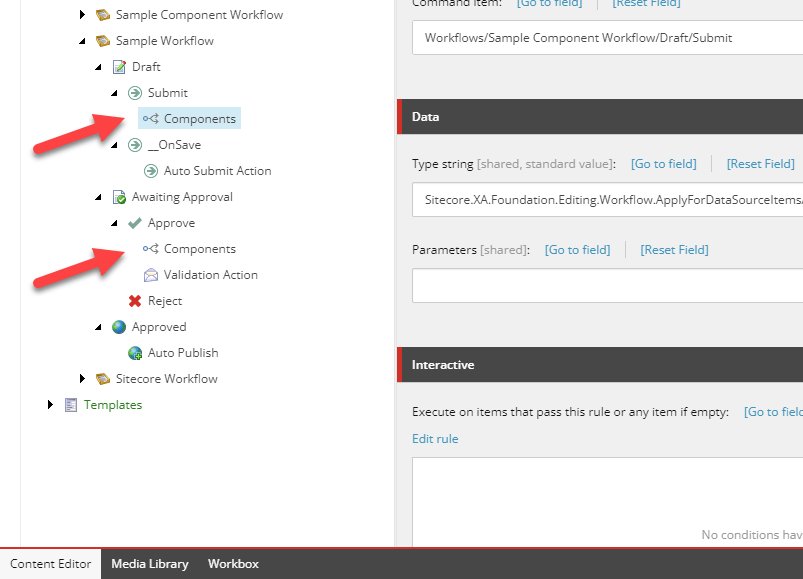
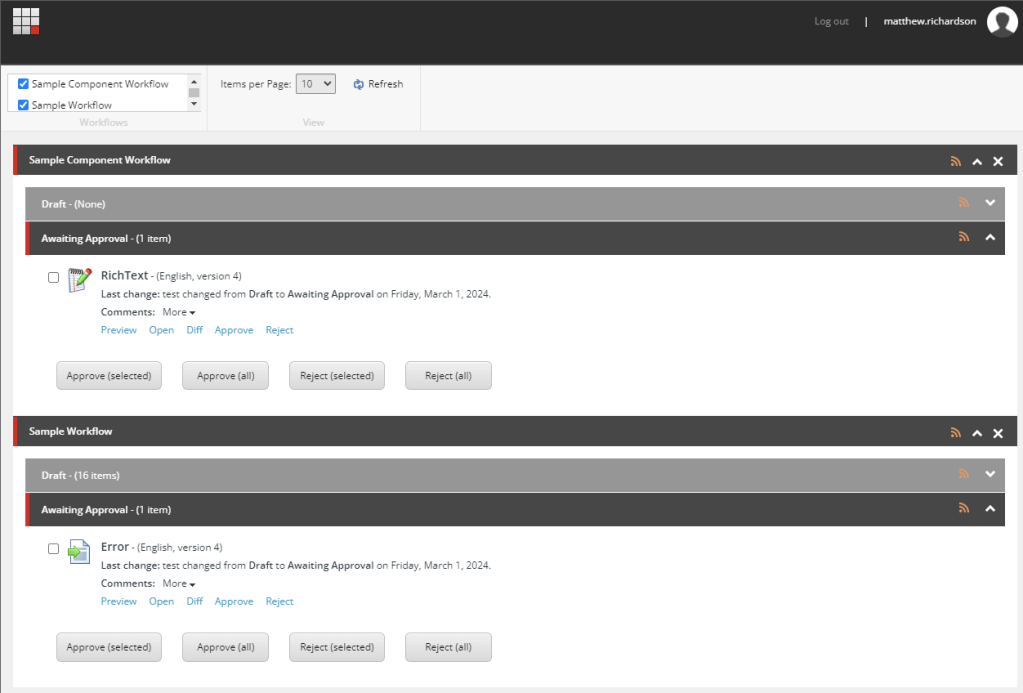
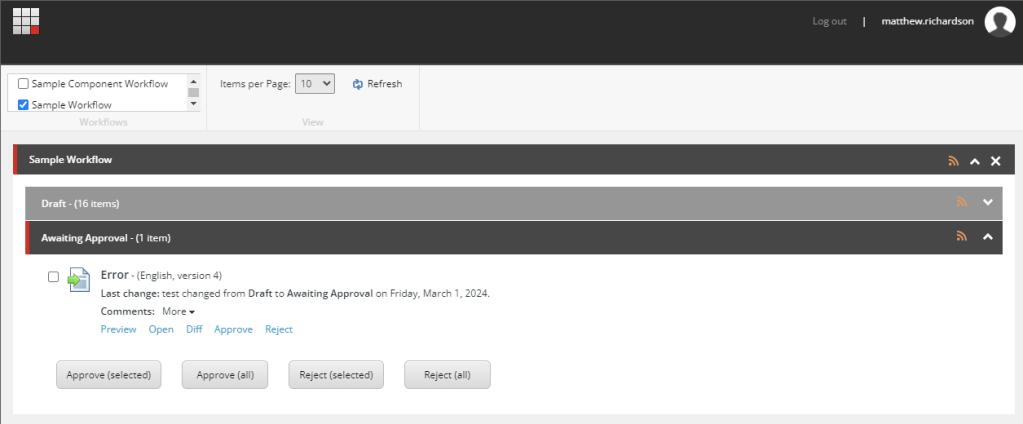
( 2 )Create a second, identical workflow for all non-page objects that have a data source. Along with former Sitecore MVP, Matt Richardson, we tested a proof-of-concept on this idea, assigning a copy of the workflow to components in the Data folder of a page and created a procedure to transition the workflow states of the subitems and related items along with the page’s workflow. It worked! In the Workbox, all the content author needs to do is deselect the workflow for non-pages and their view will be once again limited to pages. And the best part about it is that it does not require any customization to the UI so it should work just as well in XM Cloud as on XP.
Example with both the page-level and component-level workflows displayedExample with just the page-level workflow is displayed
Option 2 is superior because it prevents us from having to choose between security and authorability. Feel free to try out this solution and let me know in the comments if you have found additional solutions that solve this problem.



 SITECORRELATIONS